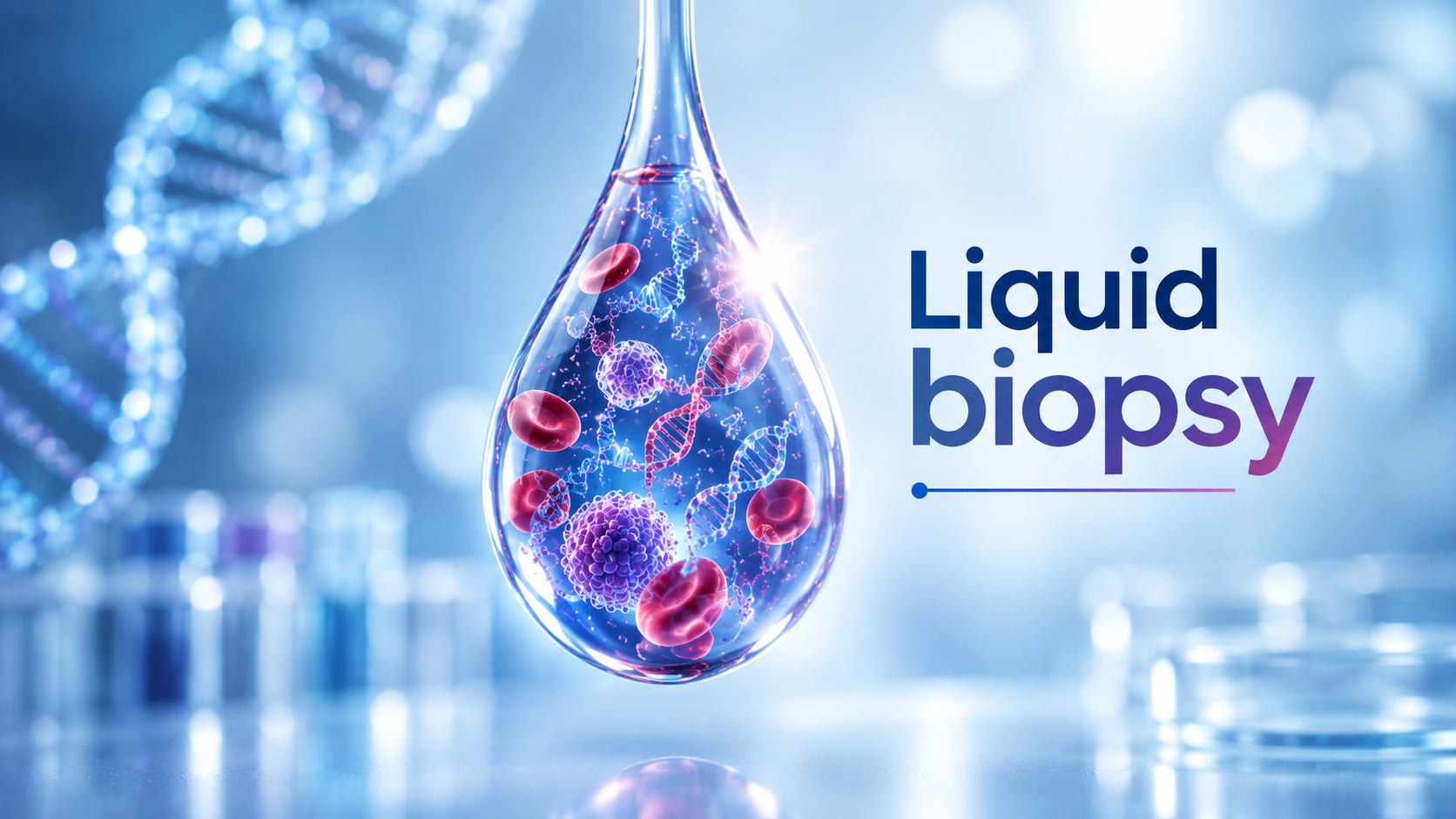
?What Is Liquid Biopsy
Liquid biopsy is a minimally invasive diagnostic approach that analyzes cancer-related biomarkers found in body fluids, most commonly blood. Unlike a traditional tissue biopsy, which requires the removal of a piece of tumor tissue, liquid biopsy can detect molecular information released by tumors into the bloodstream.
Cancer cells and tumor tissues continuously release biological materials into circulation. These materials may include circulating tumor DNA (ctDNA), circulating tumor cells (CTCs), cell-free DNA (cfDNA), RNA, .extracellular vesicles, and other molecular biomarkers
By analyzing these components, researchers and clinicians can obtain valuable information about the genetic and molecular characteristics of a tumor.
Liquid biopsy has become an important area of research in cancer genetics, molecular oncology, targeted therapy, and precision medicine. Although it does not replace conventional tissue biopsy in every clinical situation, it provides a complementary source of information that can be particularly valuable when obtaining tumor tissue is difficult or when repeated molecular monitoring is needed.

?Why Is Liquid Biopsy Important in Cancer
Cancer is not a static disease. Tumors can evolve over time and may develop new genetic alterations, particularly under the selective pressure of treatment.
A tissue sample provides information about the tumor at a specific location and time. However, obtaining multiple tissue biopsies throughout the course of a patient's disease may be difficult, invasive, or impractical.
Liquid biopsy offers a different approach.
Because tumor-derived material can enter the bloodstream, a blood sample may provide molecular information about the cancer without requiring repeated surgical procedures.
Potential applications include:
Detecting cancer-associated molecular alterations
Identifying biomarkers that may guide targeted treatment
Monitoring treatment response
Detecting molecular evidence of residual disease
Monitoring tumor evolution
Identifying emerging resistance-associated mutations
Supporting cancer recurrence surveillance
Enabling repeated molecular testing over time
These applications have contributed to the development of precision oncology, in which treatment decisions are increasingly informed by the molecular characteristics of an individual's tumor.
?How Does Liquid Biopsy Work
The basic concept behind liquid biopsy is relatively straightforward, although the laboratory techniques used for analysis can be highly sophisticated.
Step 1: Sample Collection
The most common sample is peripheral blood. Depending on the purpose of testing, other body fluids may also be investigated, including:
Urine
Cerebrospinal fluid
Pleural fluid
Saliva
Ascites
Blood remains the most widely studied source because it is relatively easy to collect and can be obtained repeatedly.
Step 2: Isolation of Biomarkers
After sample collection, laboratory procedures are used to isolate specific components from the biological sample.
Depending on the test, researchers may analyze:
Cell-free DNA
Circulating tumor DNA
Circulating tumor cells
RNA
Extracellular vesicles
Proteins and other molecular biomarkers
Step 3: Molecular Analysis
The isolated material can then be analyzed using molecular technologies such as:
PCR
Digital PCR
Next-Generation Sequencing (NGS)
Targeted sequencing
Whole-exome sequencing in selected research settings
Methylation analysis
The appropriate technology depends on the biomarker being investigated and the clinical or research question.
Step 4: Interpretation
The resulting molecular data are interpreted to identify clinically relevant alterations or patterns.
For example, sequencing of circulating tumor DNA may reveal a mutation associated with a specific targeted therapy or a molecular alteration associated with treatment resistance.

What Is Circulating Tumor DNA (ctDNA)?
One of the most important components analyzed in liquid biopsy is circulating tumor DNA (ctDNA).
Cells naturally release fragments of DNA into the bloodstream. This DNA is known as cell-free DNA (cfDNA).
When some of these DNA fragments originate from tumor cells, they are referred to as circulating tumor DNA.
Therefore:
cfDNA = DNA fragments circulating in the blood from different sources
ctDNA = the fraction of cfDNA that originates from tumor cells
The amount of ctDNA can vary considerably depending on factors such as tumor type, tumor burden, disease stage, tumor biology, and treatment status.
Because ctDNA can carry genetic alterations found within tumor cells, its analysis can provide molecular information about a cancer.
Liquid Biopsy vs Tissue Biopsy
Liquid biopsy and tissue biopsy should not necessarily be viewed as competing technologies. In many clinical situations, they can provide complementary information.
Tissue Biopsy | Liquid Biopsy | Feature |
Tumor tissue | Blood or other body fluid | Sample |
More invasive | Minimally invasive | Invasiveness |
More difficult | Relatively easy | Repeat testing |
Yes | Yes | Molecular information |
Yes | Generally limited | Histological information |
Can be assessed | Not directly assessed | Tumor architecture |
More difficult | Potentially useful | Monitoring over time |
Usually represents sampled tissue | May capture signals from multiple sites | Tumor heterogeneity |
A tissue biopsy remains essential in many situations because it can provide histopathological information, tumor architecture, and cellular context that liquid biopsy cannot fully reproduce.
Liquid biopsy is therefore best understood as a complementary technology whose value depends on the clinical question.
Applications of Liquid Biopsy in Cancer
1. Cancer Detection
One of the most widely discussed applications of liquid biopsy is cancer detection.
Researchers are investigating whether molecular signals in blood can help identify cancer at earlier stages.
However, early-stage tumors may release very small amounts of tumor-derived DNA into circulation. This creates an important technical challenge: detecting a small cancer-associated signal among a much larger background of normal cfDNA.
For this reason, liquid biopsy for early cancer detection and cancer screening remains an active area of research, and test performance can vary substantially between cancer types and stages.
2. Molecular Profiling of Tumors
Liquid biopsy can provide molecular information about a tumor without requiring a new tissue sample.
For example, ctDNA analysis may identify alterations involving genes or pathways relevant to cancer treatment.
Depending on the cancer type and test, genomic profiling may help identify alterations associated with therapies targeting pathways such as:
EGFR
ALK
BRAF
KRAS
PIK3CA
HER2-related alterations
The clinical relevance of a detected alteration depends on the specific cancer, testing method, variant, and available evidence.
3. Treatment Selection
Precision medicine aims to match patients with treatments based on the biological characteristics of their disease.
Liquid biopsy may contribute to this process by identifying actionable genomic alterations.
For example, when sufficient tumor-derived DNA is present in a blood sample, molecular testing may identify a mutation that can help determine whether a patient could benefit from a targeted therapy.
However, a negative liquid biopsy result does not always mean that the tumor lacks a particular alteration. The result may instead reflect insufficient ctDNA in the bloodstream.
4. Monitoring Treatment Response
Another important application of liquid biopsy is treatment monitoring.
Changes in ctDNA levels may sometimes provide an earlier indication of changes in tumor burden than conventional imaging.
A decrease in tumor-derived DNA during treatment may be associated with a molecular response, while persistent or increasing ctDNA may indicate residual or progressing disease in certain contexts.
Nevertheless, ctDNA should be interpreted alongside clinical findings and imaging rather than used in isolation.
5. Detecting Minimal or Molecular Residual Disease
After apparently successful treatment, a small number of cancer cells may remain in the body.
This situation is often referred to as minimal residual disease (MRD) or, increasingly, molecular residual disease when assessed using molecular biomarkers.
Liquid biopsy is being extensively investigated as a method for detecting molecular evidence of residual cancer after treatment.
The potential advantage is that molecular changes may become detectable before a recurrence is visible through conventional imaging.
This area is particularly important in research involving colorectal, breast, lung, and other cancers.
6. Monitoring Cancer Recurrence
Following treatment, liquid biopsy may potentially help monitor patients for molecular evidence associated with cancer recurrence.
Serial blood samples can provide a dynamic picture of tumor-derived molecular signals.
Instead of obtaining information from a single biopsy, clinicians may potentially monitor molecular changes over time.
This concept is one of the major reasons liquid biopsy is attracting attention in modern oncology.
7. Detecting Treatment Resistance
Cancer cells can acquire new genetic alterations that allow them to survive targeted therapy.
Liquid biopsy may help identify these emerging resistance-associated alterations by repeatedly analyzing ctDNA during treatment.
This can provide insight into how a tumor is evolving under therapeutic pressure and, in selected clinical settings, may help inform subsequent treatment decisions.
Liquid Biopsy in Breast Cancer
Breast cancer is one of the areas in which liquid biopsy has received substantial research attention.
The analysis of circulating tumor DNA may provide information about molecular alterations associated with breast cancer and may potentially support:
Molecular profiling
Treatment monitoring
Detection of emerging resistance
Residual disease assessment
Recurrence monitoring
Research into tumor evolution
For example, genomic alterations affecting pathways such as PI3K/AKT/mTOR may have therapeutic relevance in specific breast cancer subtypes.
Liquid biopsy may also be particularly valuable for studying tumor heterogeneity, because different tumor cell populations can carry different genetic alterations.
However, the clinical usefulness of a liquid biopsy depends on the specific test, disease stage, tumor biology, and clinical context.
Liquid Biopsy and Cancer Genetics
Liquid biopsy is closely connected to the broader field of cancer genomics.
Cancer develops through the accumulation of genetic and epigenetic alterations in cells. Some of these changes can be detected in tumor-derived DNA circulating in the bloodstream.
This makes liquid biopsy an important tool for studying:
Somatic mutations
Copy-number alterations
Structural variants
DNA methylation
Tumor evolution
Clonal heterogeneity
It is important to distinguish somatic genetic alterations from germline genetic variants.
Germline variants are inherited and are present in most cells of the body. They can be relevant to hereditary cancer risk.
By contrast, many alterations detected in ctDNA arise specifically within tumor cells during cancer development.
Therefore, a liquid biopsy performed for tumor profiling is not necessarily equivalent to a hereditary genetic test.
Technologies Used in Liquid Biopsy
Different technologies can be used depending on the target biomarker and required sensitivity.
PCR-Based Methods
PCR-based methods can detect specific genetic alterations with high sensitivity.
Digital PCR (dPCR) and related approaches can be particularly useful when the laboratory is looking for known variants at very low concentrations.
Next-Generation Sequencing
Next-Generation Sequencing (NGS) allows simultaneous analysis of multiple genes and genomic regions.
Targeted NGS panels are widely investigated and used for molecular profiling because they can detect multiple classes of genomic alterations in a single assay.
Methylation Analysis
Cancer can be associated with characteristic changes in DNA methylation.
Analyzing methylation patterns in circulating DNA is therefore an active research area, particularly for the development of multi-cancer early detection approaches.
Fragmentomics
Another emerging field is DNA fragmentomics, which examines characteristics such as the size and distribution of circulating DNA fragments.
Tumor-derived DNA can exhibit distinct fragmentation patterns, potentially providing additional information beyond sequence mutations alone.

Advantages of Liquid Biopsy
Liquid biopsy offers several potential advantages:
Minimally Invasive Sampling
A blood draw is generally less invasive than obtaining tumor tissue surgically.
Repeatability
Blood samples can often be collected repeatedly, making liquid biopsy suitable for longitudinal monitoring.
Molecular Information
Liquid biopsy can provide genomic and epigenomic information about tumor biology.
Potential Detection of Tumor Heterogeneity
Circulating tumor-derived DNA may originate from multiple tumor sites, potentially capturing a broader molecular picture than a single tissue sample.
Faster Molecular Monitoring
Repeated molecular measurements may allow clinicians and researchers to observe changes in tumor-derived biomarkers over time.
Limitations and Challenges
Despite its promise, liquid biopsy has important limitations.
Low ctDNA Concentration
Some tumors release very little DNA into the bloodstream. This is particularly challenging in early-stage disease.
False-Negative Results
A blood test may fail to detect a mutation that is actually present in the tumor simply because insufficient tumor-derived DNA is present in the sample.
Biological Complexity
Tumor biology varies substantially between cancer types and even among patients with the same cancer.
Technical Sensitivity
Highly sensitive technologies are required to distinguish genuine tumor-derived alterations from background DNA and technical artifacts.
Interpretation Challenges
Not every genetic alteration detected in circulating DNA is clinically meaningful.
Tissue Information Is Still Important
Liquid biopsy generally cannot provide the same histological and architectural information as tissue biopsy.
For these reasons, liquid biopsy should be interpreted within the broader clinical context rather than as a standalone replacement for conventional diagnostic approaches.
Is Liquid Biopsy a Replacement for Tissue Biopsy?
Not in most situations.
Liquid biopsy is an important complementary technology, but tissue biopsy remains fundamental for many cancer diagnoses.
A tissue sample can provide information about:
Tumor histology
Cellular morphology
Tumor architecture
Immunohistochemical markers
Molecular alterations
Liquid biopsy primarily provides molecular information from circulating biomarkers.
In some clinical situations, liquid biopsy can be especially useful when tissue is unavailable, insufficient, difficult to obtain, or when repeated molecular monitoring is required.
The Future of Liquid Biopsy
The future of liquid biopsy is closely connected to advances in precision oncology, genomic sequencing, artificial intelligence, and multi-omics.
Researchers are increasingly exploring approaches that combine multiple types of biomarkers rather than relying on a single signal.
Future liquid biopsy platforms may integrate:
DNA + RNA + methylation + proteins + fragmentomics + clinical data
This integrated approach could potentially improve the ability to characterize cancer and monitor disease dynamically.
Artificial intelligence and machine-learning methods may also help identify complex molecular patterns that are difficult to recognize using individual biomarkers.
However, translating promising research findings into reliable clinical applications requires rigorous validation, standardized testing procedures, and evidence demonstrating clinical utility.
Conclusion
Liquid biopsy represents one of the most promising developments in modern cancer genomics.
By analyzing tumor-associated biomarkers in blood and other body fluids, liquid biopsy offers a minimally invasive way to obtain molecular information about cancer.
Its potential applications range from molecular profiling and treatment selection to treatment monitoring, detection of molecular residual disease, and investigation of tumor evolution and resistance.
At the same time, liquid biopsy has important limitations. Low levels of circulating tumor DNA, biological variability, technical challenges, and the inability to fully reproduce histological information mean that it should not automatically replace tissue biopsy.
As sequencing technologies, biomarker discovery, and computational analysis continue to advance, liquid biopsy may become increasingly important in precision oncology and personalized cancer care.
For patients and healthcare professionals, understanding both the potential and limitations of this technology is essential for making informed decisions about cancer testing and molecular diagnostics.
Frequently Asked Questions About Liquid Biopsy
?Is liquid biopsy a blood test
Most liquid biopsies use a blood sample, although other body fluids can also be analyzed.
?Can liquid biopsy detect cancer
Some liquid biopsy tests can detect cancer-associated molecular signals. However, the ability to detect cancer depends on the cancer type, stage, tumor biology, assay sensitivity, and clinical context.
Liquid biopsy should not automatically be considered a universal cancer screening test.
?Is liquid biopsy painful
Because blood-based liquid biopsy generally requires only a blood draw, it is considerably less invasive than most tissue biopsy procedures.
?What does liquid biopsy detect
Depending on the test, liquid biopsy may detect ctDNA, circulating tumor cells, RNA, methylation patterns, proteins, or other cancer-associated biomarkers.
?Can liquid biopsy replace a biopsy
Not generally. Liquid biopsy and tissue biopsy provide different types of information and may be complementary.
?What is ctDNA
ctDNA stands for circulating tumor DNA. It refers to DNA fragments released by tumor cells into the bloodstream.
?Is liquid biopsy useful for breast cancer
Liquid biopsy is an active area of breast cancer research and may have applications in molecular profiling, treatment monitoring, residual disease assessment, and recurrence research.
گفتوگو درباره این مقاله
۰ دیدگاهتجربه یا پرسش خود را محترمانه و بدون اطلاعات پزشکی محرمانه بنویسید.
هنوز دیدگاهی ثبت نشده است؛ آغازگر گفتوگو باشید.