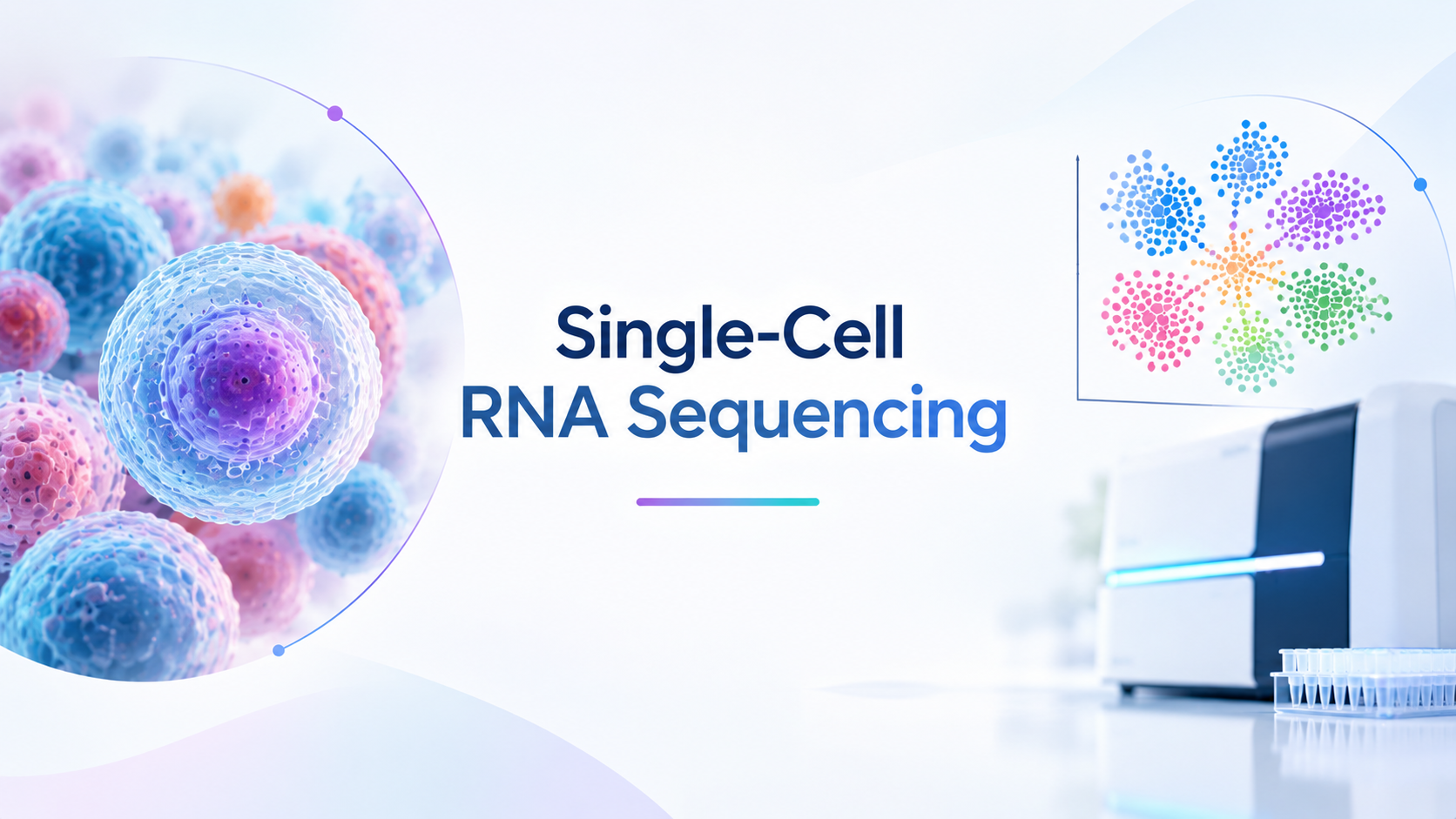
?What Is Single-Cell RNA Sequencing
Single-cell RNA sequencing (scRNA-seq) is an advanced transcriptomic technology that enables researchers to analyze gene expression at the level of individual cells. Unlike conventional bulk RNA sequencing, which measures the average RNA expression across thousands or millions of cells, scRNA-seq can reveal the molecular characteristics of individual cells within a complex biological sample
This distinction is particularly important because tissues are rarely composed of identical cells. A tumor, for example, may contain malignant cells, immune cells, fibroblasts, endothelial cells, and other stromal populations, each with distinct molecular states and biological functions.
By profiling these populations separately, single-cell RNA sequencing provides a high-resolution view of cellular heterogeneity, cell states, gene-expression programs, and interactions within tissues.
Over the past decade, scRNA-seq has evolved from a primarily research-oriented technology into an increasingly important component of translational biology, cancer research, drug discovery, and precision medicine. Recent developments are also connecting single-cell transcriptomics with spatial technologies, epigenomics, proteomics, genomic profiling, and machine learning.
Single-Cell RNA Sequencing vs Bulk RNA Sequencing
The major difference between bulk RNA sequencing and scRNA-seq is the level at which RNA molecules are measured.
In bulk RNA-seq, RNA is extracted from a population of cells and sequenced together. The resulting expression profile represents an average signal from the entire sample.
This approach is highly valuable, but averaging can conceal rare cell populations and biologically
important differences between individual cells.
In contrast, scRNA-seq assigns transcriptomic information to individual cells, allowing researchers to identify distinct cellular populations and states.
For example, if a tumor contains 90% cancer cells and 10% immune cells, a bulk RNA-seq experiment may largely reflect the dominant population. scRNA-seq can separately characterize the immune cells and investigate how their transcriptional states differ from one another.
This capability is one of the reasons single-cell RNA sequencing has become particularly influential in cancer research.
How Does Single-Cell RNA Sequencing Work?
Although experimental workflows vary depending on the platform and research question, a typical scRNA-seq experiment involves several major steps.
1. Sample Collection and Preparation
The process begins with biological material such as:
Fresh or cryopreserved tissue
Tumor samples
Blood or peripheral blood mononuclear cells
Organoids
Cell cultures
Bone marrow
Biopsy specimens
For many workflows, tissues must be dissociated into individual cells while minimizing changes in their biological state.
Sample preparation is therefore a critical stage. Poor tissue handling, excessive processing time, or cell damage can introduce technical artifacts that affect downstream interpretation.
2. Cell Isolation
Individual cells are separated or partitioned into small reaction volumes.
Modern high-throughput platforms can process thousands to hundreds of thousands of cells in a single experiment, depending on the technology and experimental design.
3. Molecular Barcoding
Each cell receives a unique molecular barcode.
RNA molecules originating from the same cell can therefore be assigned back to that cell after sequencing.
Unique molecular identifiers (UMIs) can also be incorporated to help distinguish individual RNA molecules and reduce amplification-related biases.
4. Reverse Transcription and Library Preparation
Messenger RNA is converted into complementary DNA (cDNA), followed by amplification and preparation of sequencing libraries.
The exact chemistry depends on the selected scRNA-seq technology.
5. Next-Generation Sequencing
The prepared libraries are sequenced using a next-generation sequencing platform.
The resulting sequencing reads contain information about both the RNA molecules and their cellular origin.
6. Computational Analysis
Raw sequencing data are processed using computational pipelines.
Typical analytical steps include:
Quality control
Cell and gene filtering
Normalization
Dimensionality reduction
Cell clustering
Cell-type annotation
Differential expression analysis
Pathway analysis
Trajectory or state analysis
Cell–cell communication analysis
Integration with other datasets
The computational stage is essential because scRNA-seq datasets can contain millions of measurements and substantial technical variability.
What Can Single-Cell RNA Sequencing Reveal?
One of the most important advantages of scRNA-seq is that it can answer questions that are difficult or impossible to address using conventional transcriptomics.
1. Cellular Heterogeneity
Cells belonging to the same tissue can have substantially different transcriptional profiles.
scRNA-seq can identify distinct cellular populations and subpopulations, including rare populations that may be masked in bulk sequencing experiments.
This is particularly important in cancer, where tumors can contain multiple malignant cell states as well as diverse immune and stromal populations.
2. Cell-Type Identification
Single-cell transcriptomics can help identify cell populations according to their gene-expression signatures.
Rather than relying exclusively on a small number of traditional markers, researchers can evaluate thousands of transcripts simultaneously to characterize cellular identity and functional states.
3. Cellular States
Cells of the same type are not necessarily functionally identical.
For example, T cells within a tumor may exist in different activation, exhaustion, memory, or cytotoxic states.
scRNA-seq can help characterize these transcriptional states and investigate how they change during disease progression or treatment.
4. Rare Cell Populations
Rare cells can have disproportionate biological importance.
A small population of treatment-resistant cancer cells, for example, may contribute to tumor recurrence.
Because scRNA-seq measures individual cells, it can be particularly useful for identifying such rare populations.

Single-Cell RNA Sequencing in Cancer Research
Cancer is one of the most important applications of single-cell RNA sequencing.
Tumors are not uniform masses of cancer cells. Instead, they are complex ecosystems composed of malignant cells and multiple non-malignant populations.
Recent oncology research has increasingly used scRNA-seq to investigate tumor heterogeneity, tumor evolution, the tumor microenvironment, immune responses, treatment resistance, and potential biomarkers. A 2025 review in Nature Reviews Clinical Oncology highlighted the growing interest in translating scRNA-seq findings from basic cancer biology toward clinically relevant applications.
Understanding Tumor Heterogeneity
Tumor heterogeneity describes the existence of different cellular and molecular populations within the same tumor.
Two cancer cells from the same patient may differ in:
Gene-expression programs
Differentiation state
Proliferative activity
Metabolic behavior
Drug sensitivity
Interaction with immune cells
scRNA-seq can characterize these differences at cellular resolution.
This is particularly relevant to precision oncology because understanding which cellular populations drive disease progression or treatment resistance may help researchers identify more effective therapeutic strategies.
Studying the Tumor Microenvironment
The tumor microenvironment (TME) includes the cells and extracellular components surrounding and interacting with cancer cells.
Important components include:
T cells
B cells
Macrophages
Dendritic cells
Cancer-associated fibroblasts
Endothelial cells
Other stromal populations
scRNA-seq allows researchers to characterize these populations and investigate their functional states.
For example, researchers can examine whether immune cells display activated, suppressive, exhausted, or memory-associated transcriptional programs.
Understanding the TME is particularly important for cancer immunotherapy because the immune environment can influence whether a tumor responds to treatment.

Investigating Treatment Resistance
Treatment resistance remains one of the major challenges in oncology.
A tumor may initially respond to therapy but later progress because resistant cellular populations survive treatment or emerge during tumor evolution.
Single-cell RNA sequencing can help researchers investigate these populations and identify molecular pathways associated with resistance.
Recent studies and reviews have emphasized the potential of single-cell approaches for studying resistance to targeted therapies and immune-checkpoint blockade.
Cancer Biomarker Discovery
Another important application is the discovery of potential biomarkers.
By identifying genes or cellular states associated with disease progression, treatment response, or resistance, scRNA-seq can generate hypotheses for new biomarkers.
However, an important distinction should be made: a biomarker discovered through scRNA-seq research is not automatically a clinically validated diagnostic or predictive biomarker.
Clinical translation requires independent validation, standardized methodologies, appropriate cohorts, and evidence demonstrating clinical utility.
Single-Cell RNA Sequencing and Breast Cancer
Breast cancer is particularly suitable for single-cell research because breast tumors can exhibit substantial molecular and cellular heterogeneity.
Different tumor subtypes may contain distinct malignant cell populations and microenvironmental states.
scRNA-seq can help researchers investigate:
Breast cancer cellular heterogeneity
Tumor evolution
Immune-cell populations
Cancer-associated fibroblasts
Hormone-related transcriptional programs
Therapy-resistant populations
Tumor–immune interactions
Potential therapeutic targets
For a cancer-focused scientific platform, this makes single-cell transcriptomics particularly relevant to understanding why patients with apparently similar tumors can experience different disease trajectories or treatment responses.
Single-Cell RNA Sequencing and Immunotherapy
Immunotherapy has transformed the treatment of several cancers, but not every patient responds equally.
One major research question is why some tumors respond to immune checkpoint inhibitors while others remain resistant.
scRNA-seq can profile immune and malignant cells before and after treatment, providing information about changes in cellular composition and transcriptional states.
Researchers can investigate populations such as:
Cytotoxic T cells
Regulatory T cells
Exhausted T cells
Natural killer cells
Macrophages
Dendritic cells
Tumor cells
Recent reviews have specifically highlighted the value of single-cell RNA sequencing for understanding immune checkpoint landscapes, tumor immune microenvironments, and mechanisms associated with immunotherapy response and resistance.
From Single-Cell RNA Sequencing to Single-Cell Multi-Omics
Although scRNA-seq provides powerful information about gene expression, RNA represents only one layer of cellular biology.
Modern single-cell research is therefore moving toward multi-omics, where multiple molecular modalities are measured from the same cell or integrated computationally.
These modalities can include:
RNA
DNA
Chromatin accessibility
DNA methylation
Proteins
T-cell or B-cell receptor sequences
Epigenetic information
For example, simultaneous measurement of DNA and RNA at single-cell scale can connect genetic alterations with transcriptional states. Recent work has demonstrated the growing feasibility of such multimodal approaches.
The broader goal is to move from asking:
“Which genes are expressed?”
toward a more comprehensive question:
“How do genetic, epigenetic, transcriptional, and protein-level processes interact within individual cells?”
Integrating scRNA-seq With Spatial Transcriptomics
One limitation of conventional scRNA-seq is that tissue architecture is generally disrupted when cells are dissociated.
This means that researchers may know which genes a cell expresses but lose information about exactly where that cell was located within the original tissue.
Spatial transcriptomics addresses this challenge by retaining information about the spatial organization of gene expression.
Combining single-cell and spatial transcriptomic data can therefore provide two complementary perspectives:
scRNA-seq: What is happening inside individual cells?
Spatial transcriptomics: Where are those cells and molecular states located within the tissue?
The integration of single-cell and spatial approaches is becoming increasingly important for understanding complex tissues and the organization of the tumor microenvironment.
Artificial Intelligence and Machine Learning in Single-Cell Analysis
The scale and complexity of single-cell datasets have created a major role for computational biology and machine learning.
Modern approaches increasingly use computational models to:
Identify cell populations
Annotate cell types
Integrate datasets
Predict cellular states
Model developmental trajectories
Infer cell–cell interactions
Identify disease-associated signatures
Predict responses to perturbations
A 2026 review in Nature Reviews Genetics describes an important transition in the field: single-cell analysis is increasingly moving beyond descriptive cell atlases toward mechanistic inference, perturbation analysis, and prediction, supported by machine-learning approaches.
This shift could eventually make single-cell data more useful for therapeutic discovery and precision medicine.
Emerging Advances in Single-Cell RNA Sequencing
The field continues to evolve rapidly.
One notable direction is targeted single-cell RNA sequencing. Conventional high-throughput scRNA-seq approaches may capture only a fraction of cellular transcripts, while many methods focus heavily on transcript ends. Targeted approaches are being developed to improve detection of specific transcripts or transcript regions and address some of these limitations.
Other major trends include:
Higher Throughput
Researchers are increasingly able to profile very large numbers of cells, making it possible to identify rare populations and construct increasingly comprehensive cellular atlases.
Multimodal Single-Cell Profiling
Combining RNA with DNA, chromatin, proteins, or other molecular information can provide a more complete representation of cellular biology.
Spatially Resolved Single-Cell Analysis
Integration with spatial technologies is helping researchers connect molecular identity with tissue architecture.
Perturbation-Based Single-Cell Studies
Rather than simply observing cells, researchers can perturb genes or pathways and use single-cell measurements to investigate the resulting cellular responses.
AI-Driven Analysis
Machine learning is increasingly being incorporated into cell annotation, dataset integration, prediction, and mechanistic modeling.
Together, these developments are shifting single-cell biology from descriptive profiling toward functional and predictive biology.

Challenges and Limitations of scRNA-seq
Despite its power, single-cell RNA sequencing has important limitations.
Sample Preparation Bias
Tissue dissociation can damage cells or alter gene-expression patterns.
Some cell types may also be more difficult to isolate than others, potentially introducing representation bias.
Technical Noise
Single-cell datasets are inherently sparse. Some transcripts present in a cell may not be detected, creating what are often referred to as dropout events.
High Cost and Computational Requirements
Large scRNA-seq experiments require significant sequencing capacity, computational resources, storage, and specialized analytical expertise.
Data Interpretation
Cell clustering and annotation are not entirely objective processes.
Different analytical pipelines or reference datasets can produce different interpretations. Careful quality control and biological validation are therefore essential.
Loss of Spatial Information
Traditional dissociative scRNA-seq does not preserve the original spatial position of cells within a tissue.
This limitation is one reason why integration with spatial transcriptomics has become increasingly important.
Clinical Validation
Perhaps most importantly, promising research findings should not automatically be interpreted as clinically validated tests.
scRNA-seq currently has enormous value in research and translational studies, but the path from a research finding to a routine clinical assay requires rigorous validation, standardization, reproducibility, and evidence of clinical benefit.
What Is the Future of Single-Cell RNA Sequencing?
The future of single-cell RNA sequencing is likely to involve deeper integration rather than scRNA-seq operating as an isolated technology.
The emerging direction is toward integrated datasets combining:
DNA → Epigenome → RNA → Protein → Spatial context → Cellular function
This approach could provide a more comprehensive picture of disease biology.
In oncology, the long-term goal is particularly compelling: to understand not only which mutations exist within a tumor, but also which cells carry them, how those cells behave, how they interact with the immune system, and why particular cellular populations respond or resist treatment.
Recent research has already demonstrated increasing interest in applying single-cell technologies to clinical trials, biomarker discovery, therapeutic development, and precision oncology. A 2026 review focusing on lung cancer reported hundreds of clinical studies incorporating scRNA-seq as a correlative or pharmacodynamic endpoint, while emphasizing that cost, scalability, and rigorous validation remain important barriers to routine clinical deployment.
Conclusion
Single-cell RNA sequencing (scRNA-seq) has fundamentally changed the way scientists study complex biological systems.
By moving from population-level averages to individual-cell measurements, scRNA-seq can reveal cellular diversity, rare populations, functional states, tumor heterogeneity, and interactions within the tissue microenvironment.
Its impact is particularly significant in cancer research, where understanding the diversity of malignant cells and the surrounding immune and stromal environment is essential for developing more precise therapeutic strategies.
The next generation of single-cell research is already moving beyond RNA alone. Integration with spatial transcriptomics, single-cell DNA sequencing, epigenomics, proteomics, multi-omics and artificial intelligence is creating increasingly comprehensive maps of human biology and disease.
As these technologies mature, single-cell analysis may become an increasingly important bridge between fundamental molecular research and precision medicine.
For cancer biology and genetic medicine, the central promise of scRNA-seq is not simply to generate more data. It is to understand which cells are driving disease, how those cells behave, how they interact with their environment, and how their molecular states may influence therapeutic response.
Frequently Asked Questions About Single-Cell RNA Sequencing
?What is single-cell RNA sequencing used for
Single-cell RNA sequencing is used to study gene expression at the individual-cell level. Major applications include cell-type identification, cellular heterogeneity analysis, cancer research, tumor microenvironment profiling, biomarker discovery, developmental biology, drug discovery, and investigation of treatment resistance.
?What is the difference between RNA-seq and scRNA-seq
Bulk RNA-seq measures the average gene-expression profile of a population of cells, whereas scRNA-seq measures gene expression at single-cell resolution.
?Why is scRNA-seq important in cancer research
Cancer is highly heterogeneous. scRNA-seq can identify distinct malignant and non-malignant cell populations, characterize tumor microenvironments, investigate treatment resistance, and identify cellular states associated with disease progression or therapeutic response.
?Can scRNA-seq diagnose cancer
scRNA-seq is primarily a research and translational technology and should not automatically be considered a routine diagnostic test. Findings generated through scRNA-seq research require clinical validation before they can be used as standardized diagnostic or predictive assays.
?Can single-cell RNA sequencing help identify treatment-resistant cells
Yes. scRNA-seq can identify cellular populations and transcriptional states associated with resistance, helping researchers investigate how resistant populations arise and which biological pathways may contribute to treatment failure.
?Is scRNA-seq better than bulk RNA sequencing
Neither technology is universally “better.” They answer different questions. Bulk RNA-seq is often more cost-effective and provides robust population-level measurements, whereas scRNA-seq offers much greater resolution for studying cellular heterogeneity.
گفتوگو درباره این مقاله
۰ دیدگاهتجربه یا پرسش خود را محترمانه و بدون اطلاعات پزشکی محرمانه بنویسید.
هنوز دیدگاهی ثبت نشده است؛ آغازگر گفتوگو باشید.